Guided media, which are those that provide a conduit from one device to another, include Twisted-Pair Cable, Coaxial Cable, and Fibre-Optic Cable. A signal travelling along any of these media is directed and contained by the physical limits of the medium.

Twisted pair cable
There are main three types of Guided media.
1:Twisted pair Cable
2:Coaxial Cable
3:Fiber optics Cable
1: Twisted Pair Cable
Twisted pair cabling is a type of wiring in which two conductors of a single circuit are twisted together for the purposes of improving electromagnetic compatibility. There are two main types of twisted pair cables, unshielded twisted pair (UTP), and shielded twisted pair (STP), which contains each pair of wires within an aluminium foil shield for further isolation. Twisted Pair cables are used in telephone lines to provide data and voice channels. The DSL lines make use of these cables. Local Area Networks (LAN) also make use of twisted pair cables. They can be used for both analog and digital transmission.Twisted Pair cables are used in telephone lines to provide data and voice channels. The DSL lines make use of these cables. Local Area Networks (LAN) also make use of twisted pair cables. They can be used for both analog and digital transmission.
Q: Who it works? A pair of wires forms a circuit that can transmit data. The pairs are twisted to provide protection against crosstalk, the noise generated by adjacent pairs. When electrical current flows through a wire, it creates a small, circular magnetic field around the wire. … Thus, the two magnetic fields cancel each other out.
2: Coxiable Cable
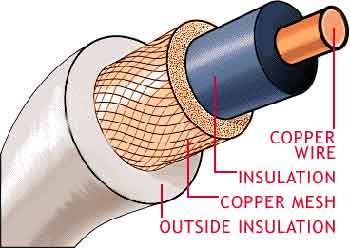
Definition. Coaxial cable is a type of cable that has an inner conductor surrounded by an insulating layer, surrounded by a conductive shielding. Many also have an insulating outer jacket The diagram below illustrates the construction of a typical cable. Electrical signal flows through the center conductor.Coaxial cable is a type of cable that has an inner conductor surrounded by an insulating layer, surrounded by a conductive shielding. Many also have an insulating outer jacket The diagram below illustrates the construction of a typical cable. Electrical signal flows through the center conductor.
Why is it called coaxial cable?
Coaxial cable received its name because it includes one physical channel that carries the signal surrounded — after a layer of insulation — by another concentric physical channel, both running along the same axis. The outer channel serves as a ground.

3: Fiber Optics Cable
}A fiber optic cable is a network cable that contains strands of glass fibers inside an insulated casing. They’re designed for long-distance, high-performance data networking, and telecommunications. Compared to wired cables, fiber optic cables provide higher bandwidth and transmit data over longer distances.
}A fiber-optic cable contains anywhere froma few to hundreds of optical fibers within a plastic casing. Also known as optic cables or optical fiber cables, they transfer data signals in the form of light and travel hundreds of miles significantly faster than those used in traditional electrical cables
}Optical fibers are used most often as a means to transmit light between the two ends of the fiber and find wide usage in fiber-optic communications, where they permit transmission over longer distances and at higher bandwidths (data transfer rates) than electrical cables.
Unguided Media
An unguided media type transmission is used to transmit electromagnetic waves without using any of the physical transmission media. Thus it is also called wireless transmission. Unguided media type includes air as the media where electromagnetic energy can be flown easily without any intrusion or hindrance.
Radio Transmission
In radio transmission a radiating antenna is used to convert a time-varying electric current into an electromagnetic wave or field, which freely propagates through a nonconducting medium such as air or space. … Radio wave propagation is not constrained by any physical conductor or waveguide.
Micro wave Transmission
Microwave transmission is the transmission of information by electromagnetic waves with wavelengths in the microwave range (1 m – 1 mm) of the electromagnetic spectrum. … 10, which used microwave relays to multiplex eight telephone channels over long distances.
Infra Red Wave
Infrared, sometimes called infrared light, is electromagnetic radiation with wavelengths longer than those of visible light. It is therefore invisible to the human eye. IR is generally understood to encompass wavelengths from around 1 millimeter to the nominal red edge of the visible spectrum, around 700 nanometers.
Satellite Transmission
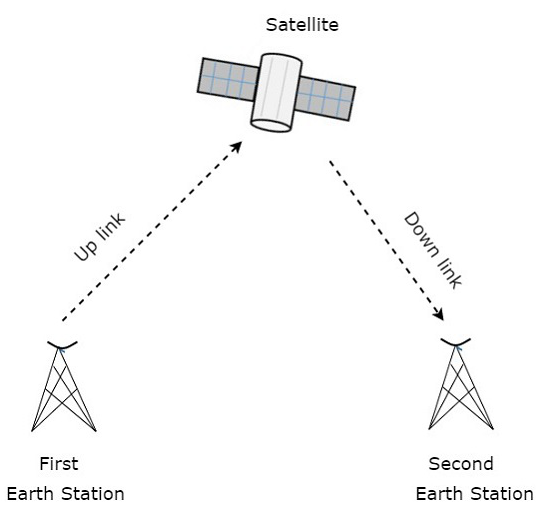
Satellite radio system is – according to article 1.111 of the International Telecommunication Union´s ITU Radio Regulations – defined as «A space system using one or more artificial earth satellites.» Each system shall be classified by the service in which it operates permanently or temporarily. See also Wikipedia
 Difference between Guided and Unguided Media